
 Get App
How to Help Your Child Overcome Math Fear at Home: A Visual Guide to Early Number Sense (LKG to Grade 3)

EduModes Editorial Team
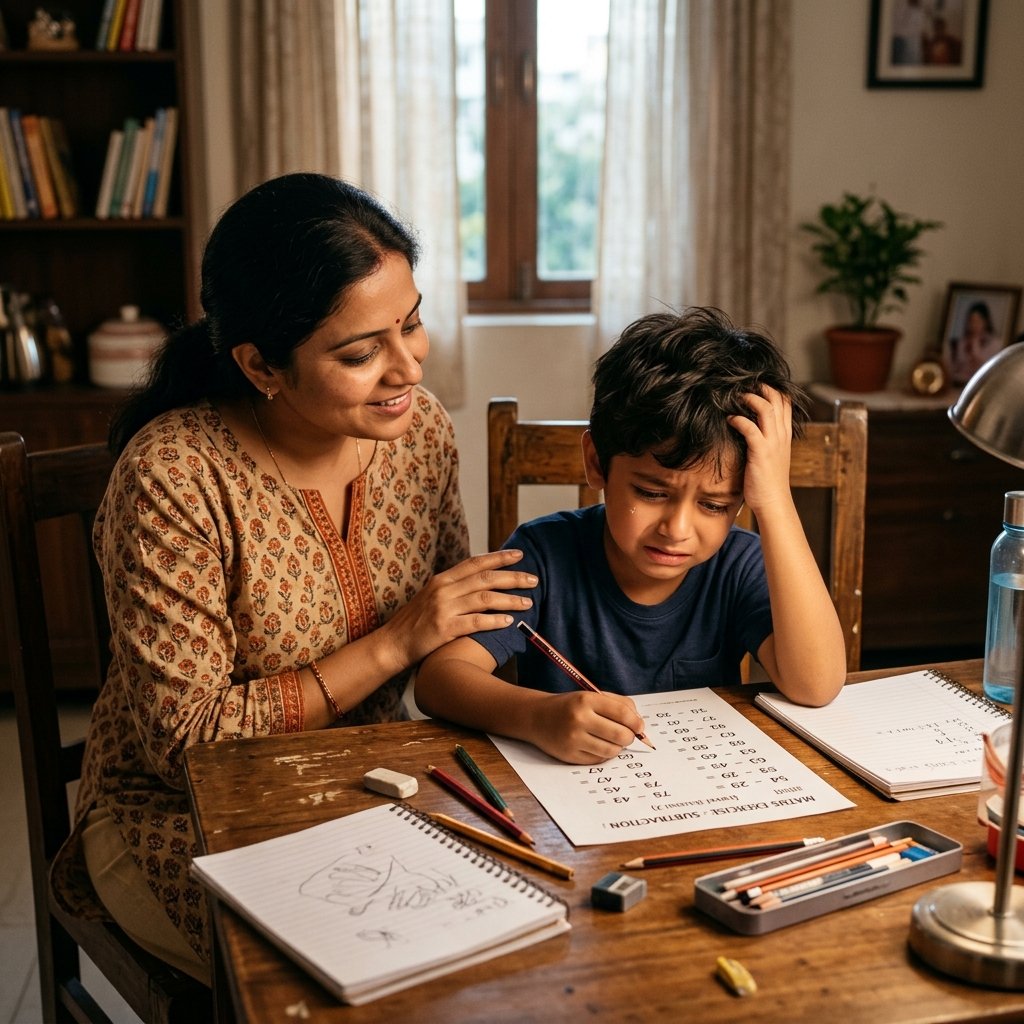
If your child sighs, freezes, or says "I'm just bad at math" whenever a textbook opens, you are witnessing early math anxiety. Studies show that math anxiety often begins as early as 5 or 6 years old—not because children lack numerical ability, but because traditional rote counting and rapid flashcard drills create panic.
When a child feels anxious during math practice, their nervous system enters a subtle "fight or flight" response. The working memory capacity needed to analyze mathematical patterns is temporarily blocked by anxiety. Removing countdown timers and introducing spatial visualization transforms how young minds experience numbers.
Key Educational Insight
Math is not about how fast a child can calculate—it is about visualizing relationships between quantities. Shifting from speed drills to visual number sense eliminates fear and unlocks genuine math enthusiasm.
1. Why Rote Speed Drills Trigger Childhood Math Anxiety
For decades, early math instruction relied on speed tests and rapid flashcards. While well-intentioned, cognitive science shows that timed drills penalize reflective thinkers and reward superficial memorization.
❌ Pressure-Based Flashcards
Focuses purely on memorization speed. Causes heart rate spikes, self-doubt, and long-term avoidance of math tasks in primary school.
✅ Visual Ten-Frame Exploration
Allows children to touch, move, and visualize quantities (e.g. seeing 7 as 5 + 2 on a grid). Builds spatial intuition and deep confidence.
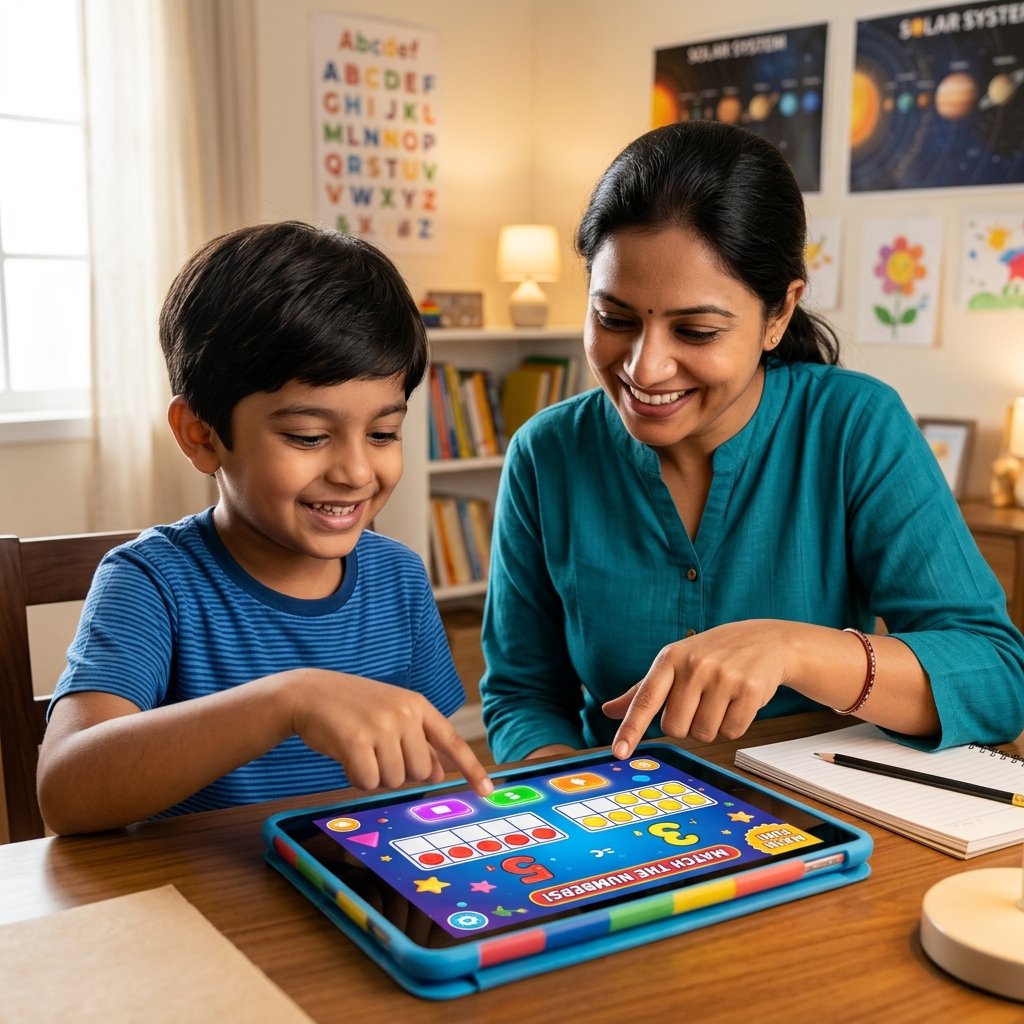
Visual micro-flips make abstract numbers tangible and stress-free for young learners.
2. The 4 Stages of Early Math Mastery (LKG to Grade 3)
Building mathematical confidence requires matching visual tools to your child's developmental stage:
Stage 1: Subitizing & Object Counting (LKG)
Instantly recognizing small quantities (like dots on a die) without counting one-by-one. Use physical buttons or visual dot cards at home.
Stage 2: Ten-Frames & Number Bonds (UKG)
Understanding anchor numbers 5 and 10 visually (e.g. knowing 8 is 2 less than 10). This prevents finger-counting dependency.
Stage 3: Skip-Counting & Pattern Recognition (Grade 1 & 2)
Counting by 2s, 5s, and 10s using interactive number lines before starting multiplication tables.
Stage 4: Place Value & Mental Word Problems (Grade 3)
Breaking multi-digit numbers into hundreds, tens, and ones with step-by-step audio hints.
3. Four Practical Steps to Eradicate Math Anxiety at Home
Eliminate Timers and Speed Pressure
Never use countdown timers during home practice. Allow your child as much time as they need to figure out a problem visually.
Use Bilingual Audio Explanations
When a math word problem feels confusing in English, let your child listen to natural Malayalam audio hints to clarify the story context.
Praise Reasoning, Not Just Right Answers
When your child makes a mistake, ask: "How did you reach that number?" Praise their logical attempt rather than correcting them harshly.
Integrate Math into Daily Household Fun
Ask your child to count change, measure ingredients for baking, or calculate items needed for grocery shopping.
4. Frequently Asked Questions (FAQ)
Q: What should I do if my child says "I'm bad at math"?
Reframe their statement immediately: "You aren't bad at math—you just haven't practiced this specific pattern yet!" Avoid saying "I was never a math person either", as children mirror parental attitudes.
Q: How many minutes a day should an LKG or UKG child practice math?
10 to 15 minutes of play-based visual flips daily is ideal. Consistency in short micro-bursts builds permanent number sense far better than 1-hour weekend study marathons.
Transform Math Fear into Joyful Discovery
Explore 1,000+ interactive visual Math flips for LKG to Grade 3 with ten-frames, number lines, and bilingual audio support.
Transform how your child learns.
Give your child access to premium, distraction-free educational resources. Try EduModes today and build a better digital foundation.